

Indigenous activists fight for land rights and cultural preservation
Activists Kahina Abayatara and Ikihie are fighting for land rights and the preservation of their indigenous culture in Dominica and Suriname. “Young people who learn about their indigenous culture will naturally become forest protectors.”
During the Global Land Forum in Colombia last June, young land rights activists from South America and the Caribbean came together to exchange experiences. It soon became clear that they had a lot in common. Ikihie from Suriname and Kahina Abayatara, who lives on the Caribbean island of Dominica, are concerned about young people leaving their communities. That is why they both founded organisations that reconnect young people with their culture.
Two names, two identities
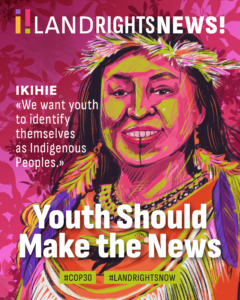 “Officially, my name is Sharmaine Artist,” says Ikihie. “People in the city still call me by that name. But I prefer Ikihie. It means fire.” Ikihie is part Lokono, one of the oldest indigenous peoples in Suriname, and part Kari’na, also known as Caribs, who are historically related to the original inhabitants of the Caribbean islands. “I dreamed that the ancestors of my community gave me that name. I don’t speak their language, but my grandmother explained to me what it means.”
Kahina Abayatara nods in agreement. “I also have two names and therefore two identities. Maureen Valmond is the professional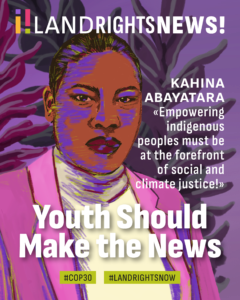 in me when I am working at the hospital. It is the name I use when I need to be diplomatic and work with stakeholders to get their approval for the projects my organisation is working on. It is the name I am registered with in Dominica, but it is also the name of the coloniser.” Kahina abayatara means ‘sharp point’, she explains. “I embrace that name when it’s time to speak up courageously and boldly, to tell it like it is. This name is who I am. I also think my community, the Kalinago, wants me to bear this name so that they have someone who can express and represent their concerns.”
Struggle for land rights and recognition
The Kalinago are one of the original people of the Windward Islands. Today, Dominica and Saint Vincent are home to the largest number of Kalinago, with around three thousand people per island. Dominica is home to the autonomous Kalinago territory. Since 1978, the Kalinago have had collective land rights there, as the only indigenous community in the Caribbean. The territory is therefore sometimes seen as the last place with an indigenous presence in the entire region.
Threatened habitats in Suriname
In contrast, the land rights of the Lokono are not formally recognised by the Surinamese state. “Surinam is the only Latin American country that does not grant land rights to its indigenous population,” says Ikihie. In total, only 3.7 percent of the Surinamese population is indigenous. Their habitats are threatened by logging, illegal mining and large-scale agriculture. Food, water and medicinal plants are becoming increasingly scarce. The Lokono are also underrepresented in politics.
But there is hope. On International Day of the World’s Indigenous Peoples, the recently sworn-in Surinamese president Jennifer Geerlings-Simons announced that her government has the ambition to grant land rights to the indigenous and tribal peoples of Suriname. Geerlings-Simons wants to better map their habitats and subject economic activities in the areas to additional conditions so that they can be better protected.
Rights, but no land
Despite collective land rights and national recognition of their territory, the Kalinago face many social, economic and ecological problems. Land rights protect the community from external exploitation, but what happens to the land is decided by the Kalinago Council, the territory’s governing body. Residents do not have individual land titles and therefore no access to land for agriculture, loans or investments. This causes inequality and keeps the local economy small, which sometimes causes tensions within the community. As a result, many Kalinago live in poverty. Basic services such as education and healthcare are available, but are of lower quality than elsewhere on the island.
How the climate crisis affects the Kalinago
Dominica is also very vulnerable to natural disasters due to the escalating climate crisis. In 2017, the exceptionally powerful Category 5 Hurricane Maria swept across the island, destroying everything in its path. At least 65 people lost their lives and the island suffered damage amounting to 931 million dollars. “It’s not fair,” says Kahina Abayatara. “We are not the ones causing this climate chaos. We are just a tiny dot on the map. But when Hurricane Maria passed over our island, everything on Dominica was wiped out. We lost everything: our homes, crops, medicinal plants in the forest, the materials we use to weave baskets.”
But there was another loss. “We lost our young people,” says Kahina Abayatara.
There was nothing left for them in the community : no work, no opportunities, no prospects. This is the loss of the climate crisis that cannot be expressed in economic terms. In the capital, they blend into the predominantly Afro communities and lose touch with their indigenous background.
There was nothing left for them in the community
Assimilation as the greatest threat
Kahina Abayatara’s organisation, Kopounoule Inc., has conducted thorough research into the relationship between the climate crisis and the loss of their culture. The conclusion: “assimilation into the dominant culture” is currently the greatest threat to the Kalinago. And this is being fuelled by the climate crisis.
The organisation is also investigating the impact of the climate crisis on the health and mental wellbeing of young people in their community, particularly women. They organise all kinds of activities to reconnect Kalinago youth with their culture. “Together with them, we are going back to planting trees and caring for the forest again,” says Kahina Abayatara. “We are learning to respect our environment, as well as our customs: basket weaving, our medicinal herbs and traditional dishes. Young people should at least have the option and, moreover, the right to remain part of their community.”
“Our connection to the land is our most precious asset.”
To foster a sense of pride and a deeper connection to their background, young people are paired with the old masters of their community through a mentorship programme. In this way, their skills are passed on to the next generation. “First we survived colonialism, then natural disasters such as Hurricane Maria. Climate justice would be if our young people were given the opportunity to preserve their culture.”
Spiritual connection to the land
“When you grow up in an indigenous community, you don’t have many choices,” Ikihie agrees. Many young people therefore choose to leave. “Only if you feel very strongly connected to your indigenous identity they come back to their communities. I come from a spiritual family. The spiritual bond we have with the land, the connection we feel, is our most precious possession. Our young people are losing sight of that connection.”
With KHOSE (Key Holders Of Sustainable Environment), the organisation that Ikihie founded together with young people from her community, she wants to reintroduce indigenous young people in Suriname to their cultural identity and the knowledge of their ancestors. “In doing so, we are not only saving their culture,” she says, “but also preparing young people to become champions of climate justice. Young people who learn about our ancient norms, values, customs and stories naturally become forest protectors. We try to make them feel appreciation and love for who they are and where they come from. Then they are also willing to stand up and fight for their original habitat.”
KHOSE also connects young people with older members of their community: through storytelling workshops, they focus together on rediscovering identity and leadership. The organisation trains young people to know their rights, make decisions and stand up for themselves and their community. KHOSE also tries to rekindle their love for traditional customs. They make jewelry and bags together, or prepare medicine made from forest products. In doing so, they also encourage entrepreneurship among young people, who can sell the products at the market or to tourists. KHOSE also recently organised Miss Indigenous Suriname, where young women could develop their leadership potential. And during the Indigenous Games, young people came together in sports and games.
Successful cooperation, but with blind spots
In recent years, NGOs and donors have been working more and more with indigenous communities. Money is being made available for their nature conservation projects, because NGOs have realised that they are the ‘best and most cost-effective nature conservationists’ and thus contribute to climate goals. Even though indigenous people make up only 6 per cent of the world’s population, they collectively manage about a quarter of the world’s natural areas, which are exceptionally rich in species and ecosystems. The research is clear: projects in collaboration with indigenous communities are exceptionally successful. But there is a downside: are the other issues, such as their marginalised position and the loss of their culture, being taken into account?
What good is climate justice when people are hungry?
Kahina Abayatara wants to give advice to people who work for large, international climate organisations.
“Few people talk about the responsibility that the international community has placed on indigenous people to save nature and the climate. You expect us to perform miracles. That is a heavy burden. First you colonised us, and now we get the smallest slice of bread (little financial resources – ed.) to solve a problem that we did not cause, but which affects us the most!”
Climate justice starts with basic needs
The projects of KHOSE and Kopounoule Inc. are also funded by Oxfam Novib. However, the women’s organisations decide for themselves how the money is used. “We must not focus solely on tackling climate change,” says Kahina Abayatara. “Indigenous people around the world will go to bed without dinner. What good is climate justice when people are hungry? Through our cultural activities, we not only give young people back their identity, but also economic opportunities. And with a renewed interest in their culture, they will inevitably contribute to climate action.”
This article was originally published in Dutch in Down to Earth magazine: Inheemse activisten strijden voor landrechten en behoud van cultuur (October, 2025)