


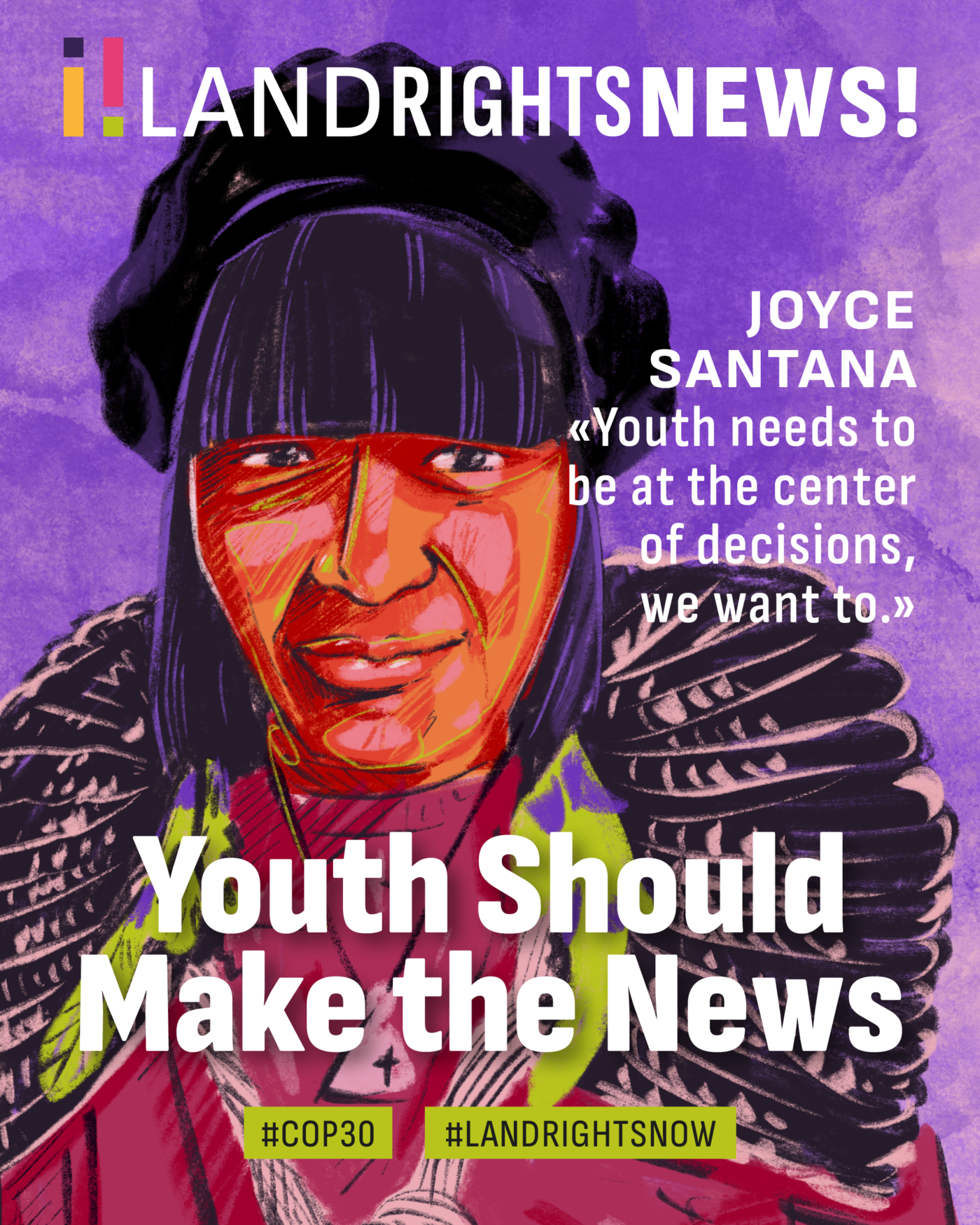
“If we stop speaking our language, we stop existing”
Joyce Santana on the Caatinga, climate justice, and Indigenous youth power
At 26, Joyce Santana carries her people’s past and future in her voice. She is an Indigenous woman from the Fulni-ô people of Águas Belas, in the semi-arid hinterlands of Pernambuco, in Brazil’s Northeast. Today, she lives as what she calls an “Indigenous of the capital,” in the metropolitan region of Recife, in São Lourenço da Mata. Joyce is an Indigenous activist, a youth ambassador and part of a generation fighting for water, food, land, and recognition in one of Brazil’s most misunderstood biomes: the Caatinga.
“Our activism starts in childhood”
For Joyce, activism does not begin with a title; it begins with survival. She explains her activism started in childhood, long before anyone named it. When young people fight for access to clean water, healthy food, and the minimum conditions for life.
Her political work became more visible through her involvement with the Landless Workers’ Movement (MST), where she worked for four to five years with children in settlements and encampments, helping them understand that they had rights to land, water, food, and dignity. In these spaces, landless rural workers and Indigenous communities worked collectively.
Climate impacts were already visible: seeds that no longer germinated, planting cycles breaking from ancestral rhythms, and rains that came irregularly or not at all. For Joyce, these were not natural variations but human-driven changes disproportionately affecting communities that contributed least to the crisis.
The Fulni-ô territory: language, ritual, and resistance
The Fulni-ô territory lies in Águas Belas. Outsiders often described the Fulni-ô as isolated because they kept more distance from non-Indigenous society than other peoples in the region, but what was labelled isolation functioned as protection. The Fulni-ô speak Yatê as their first language and Portuguese only as a second language. They are the only Indigenous people in Pernambuco state, and one of the very few in the Northeast, who maintain a native language as the everyday language of the community.
We say that if one day we stop singing and speaking our language, we cease to exist, language and song are our identity.
When food stops coming from the land
The Fulni-ô territory has seen profound change in only a few generations. Joyce recalls that elders planted their own crops and ensured their own food supply, while today that practice is quickly disappearing. Water scarcity, contaminated rivers, and a drier, more irregular climate make agricultural production difficult, forcing families to purchase processed food and weakening food autonomy and community health. With limited access to potable water outside sacred areas, many are pushed into dependence on fragile supply chains rather than the land itself.
The side effects
Joyce identifies land leasing (“arrendamento de terra“) to outsiders as one of the most serious current threats. The practice offers guaranteed income for communities facing scarcity, but leased lands are used for cattle, deforestation, and unregulated construction on Indigenous land.
Parts of the Fulni-ô territory were demarcated formally, and another part was historically secured after forced participation in the War of Paraguay, when Princess Isabel signed a document recognizing Indigenous possession. That document, today stored at the Museu do Índio in Rio de Janeiro, stands as proof of ancestral rights. Nevertheless, municipal expansion reduces Indigenous space. Águas Belas is visibly divided: the urban non-Indigenous zone has expanded with concrete and little vegetation, while the Indigenous area remains greener and more preserved. Seen from above, the aldeia is defined by intact Caatinga rather than construction.
Joyce’s primary attachment to her territory is relational rather than geographic. Collectivity, she says, is lived from childhood. Meals are shared, and households keep their doors open so that relatives who did not cook can come in and eat without notice. In the capital, houses are closed and social logistics require warning, which transforms the meaning of community. Joyce also refers to the sacred objects she carries as protection. At the center of cultural continuity are songs in Yatê, which sustain spiritual, cultural, and political identity. As she affirms, if the community stops singing or speaking, they stop existing as a people.
The Caatinga under threat: “a unique biome treated as if it were worth nothing”
Joyce’s current activism focuses on defending the Caatinga, a biome frequently dismissed as an empty or barren landscape but critical to survival and climate stability. She notes that the Caatinga has significant carbon capture potential and provides essential materials for crafts, medicinal plants, straw for baskets and mats, and food resources that define cultural life.
However, severe drought undermines planting, and communities are unable to channel water from hills to fields. Simultaneously, wind-energy projects are expanding across the biome in the name of an energy transition, with turbines placed near Indigenous territories without prior consultation. Noise, land degradation, and deforestation accompany the installation process. Some companies clear land, fail to complete projects, and leave damaged areas without reforestation or compensation. Joyce argues that a just transition would include consultation, respect for territorial rights, and ecological restoration. Without these, the transition is imposed rather than collective and becomes another source of dispossession.
Bringing Caatinga and youth voices to COP
Joyce went to COP30 in Belém to bring the narratives of her people and claim political space for Indigenous youth.
She emphasizes that elders have carried political struggles for a long time but can no longer travel or participate, making it necessary for youth to continue the path they opened. She challenges stereotypes of disengaged youth and highlights innovations in circular economy and sustainability.
For a long time, we Indigenous people have been silenced, erased from history. We still are. People talk about Indigenous issues, but when you look for representation, we’re not there. There is always someone else speaking for us.
For Joyce, is an opportunity to insist that Indigenous territories are climate solutions, demarcation is climate policy, and ancestral knowledge is essential to planetary survival. She critiques the contradiction of debating continued deforestation during a climate emergency and stresses that Indigenous peoples bring both ancestral and future-oriented perspectives.
From the white heat of the Caatinga, from a people who sing in Yatê so they do not disappear, Joyce Santana embodies a generation asserting that they are not remnants of the past, but protagonists of the future.
You can follow Joyce on Instagram: @joysantana__